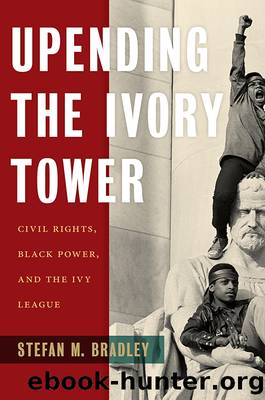
Upending the Ivory Tower by Stefan M. Bradley
Author:Stefan M. Bradley
Language: eng
Format: epub
Publisher: New York University Press
7
Blue Bulldogs and Black Panthers
Yale, New Haven, and Black Imaginings
At Yale I came to realize that my presence violated one of the deepest taboos in American Lifeâthe racial boundary hedged around the life of the mind.
âPhillip M. Richards, 2006
New Haven, Connecticut, home of Yale University, garnered national attention in 1970 for two reasons. That year, the city hosted the murder trials of Bobby Seale and Ericka Huggins, members of the Black Panther Party for Self Defense, as well as twelve others.1 The well-covered courtroom drama reached households across the nation as Black Nationalism itself seemed to be on trial. Images of Bobby Seale with tape over his mouth symbolized, to many, the inability of black America to effectively tell its side of the national narrative. To those who were not sympathetic to the Panthers, the tape worked to impede, what non-sympathizers considered, divisive rhetoric.2
Also in 1970, Yale became ground zero for opponents of U.S. intervention in the Vietnam War during the May Day protest. Hundreds of students from across the country descended upon the campus to protest the nationâs escalation in the war effort and to demand that Yale extricate itself from making any contributions to the controversial conflict in Southeast Asia. Rebellion and resistance with regard to race, racism, and war were prevalent on and off campus. The Panthers, whose style and affect was catching, could be clearly identified as representatives of Black Power in their apparel, stances, rhetoric and actions.
This chapter argues that for as important as the militancy of the Panthers was to the movement, so too was the methodical campaign that black students waged for the first recognized Black Studies program in the Ivy League. Those students contributed as much to Black Power as the firearm-wielding, Mao Tse-tung quoting Black Panthers. Similarly, the challenge to the traditional curriculum of Yale matched the spirit of the push against the war that mostly white students made on the campus. The rise of Black Studies in the Ivy League played a significant role in the ascendance of youth and counterculture, as well as youth empowerment.
The efforts of black student activists were paying dividends as the Ivy League steadily increased its population of African American learners. According to an article in Yale Alumni Magazine, the eight Ivy League institutions and their âSister Schoolsâ (Mount Holyoke College, Vassar College, Wellesley College, Smith College, Radcliffe College, Bryn Mawr College, and Barnard College) doubled their black student acceptance rates between the 1967â1968 and 1968â1969 school years.3 The article indicated that institutional officials realized that perhaps they had not been as committed to equalizing educational opportunity in the past as they should have been. Members of black student organizations on Ivy campuses helped administrators to recognize the potential for the good institutions could do if they opened their doors to previously nontraditional students.
Admission was only the first step in creating better life chances for black students. Once on campus, many black students needed to feel a sense of belonging. The article insightfully pointed out
Download
This site does not store any files on its server. We only index and link to content provided by other sites. Please contact the content providers to delete copyright contents if any and email us, we'll remove relevant links or contents immediately.
| Africa | Americas |
| Arctic & Antarctica | Asia |
| Australia & Oceania | Europe |
| Middle East | Russia |
| United States | World |
| Ancient Civilizations | Military |
| Historical Study & Educational Resources |
The Dawn of Everything by David Graeber & David Wengrow(1759)
The Bomber Mafia by Malcolm Gladwell(1664)
Facing the Mountain by Daniel James Brown(1596)
Submerged Prehistory by Benjamin Jonathan; & Clive Bonsall & Catriona Pickard & Anders Fischer(1494)
Wandering in Strange Lands by Morgan Jerkins(1481)
Tip Top by Bill James(1480)
Driving While Brown: Sheriff Joe Arpaio Versus the Latino Resistance by Terry Greene Sterling & Jude Joffe-Block(1410)
Red Roulette : An Insider's Story of Wealth, Power, Corruption, and Vengeance in Today's China (9781982156176) by Shum Desmond(1395)
Evil Geniuses: The Unmaking of America: A Recent History by Kurt Andersen(1391)
The Way of Fire and Ice: The Living Tradition of Norse Paganism by Ryan Smith(1369)
American Kompromat by Craig Unger(1359)
F*cking History by The Captain(1347)
It Was All a Lie by Stuart Stevens;(1341)
American Dreams by Unknown(1316)
Treasure Islands: Tax Havens and the Men who Stole the World by Nicholas Shaxson(1304)
Evil Geniuses by Kurt Andersen(1296)
White House Inc. by Dan Alexander(1243)
The First Conspiracy by Brad Meltzer & Josh Mensch(1212)
The Fifteen Biggest Lies about the Economy: And Everything Else the Right Doesn't Want You to Know about Taxes, Jobs, and Corporate America by Joshua Holland(1159)
